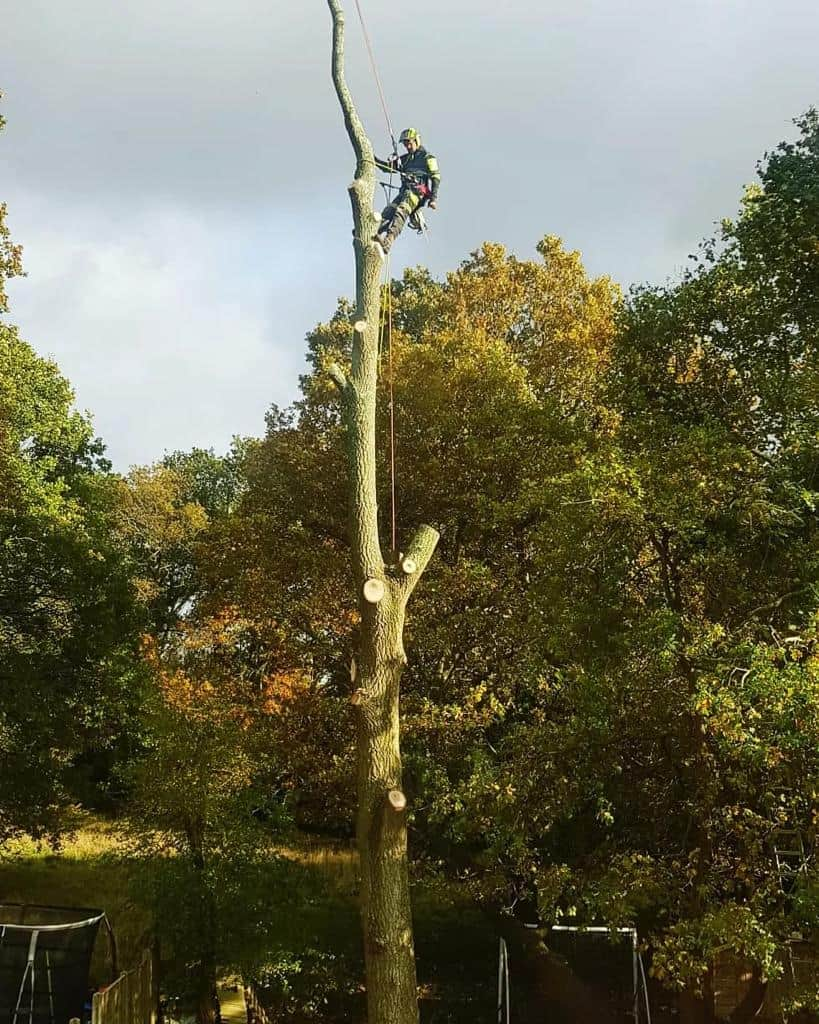
Trees can become problematic for many different reasons. Some develop substantial deadwood or structural damage, while others gradually become unsuitable for the space available as their crowns and stems mature. A tree may also begin losing major branches, declining noticeably or requiring increasingly extensive management simply to remain compatible with the surrounding garden.
However, a problematic tree does not automatically need to be felled. Crown reduction, selective pruning, deadwood removal and other forms of tree surgery can often address specific concerns while allowing an established tree to remain. The important question is whether these approaches can provide a sensible and proportionate solution.
For homeowners in Godalming, Surrey, deciding whether to retain or remove a tree should therefore begin with its actual condition and the reason it has become problematic. Professional assessment can establish whether targeted tree surgery remains appropriate or whether felling has become the more practical solution.
How Do You Know When Tree Felling Is the Appropriate Option?
Tree felling may become appropriate when the problems affecting a tree cannot reasonably be resolved through proportionate pruning or when the tree’s overall condition, structure or suitability for its surroundings has deteriorated significantly.
The decision should not be based on size alone.
A large tree may remain suitable for retention, while a smaller tree can sometimes develop significant problems. Similarly, discovering one dead branch does not automatically indicate that the complete tree is deteriorating.
The entire tree needs to be considered before deciding whether removal is justified.
A Problematic Branch Does Not Necessarily Mean a Problematic Tree
One of the most important distinctions is between a tree containing a problem and a tree that has become problematic as a whole.
An individual broken, dead or overextended branch may often be managed through selective pruning.
If the remaining crown and main structure are in suitable condition, removing the complete tree could be unnecessary.
Professional assessment helps establish whether the concern is genuinely localised before more extensive work is considered.
Extensive Decline Can Change the Situation
A tree containing one or two dead branches can be very different from a tree showing widespread decline throughout its crown.
Where substantial sections are dying back, the overall condition deserves closer investigation.
The pattern of decline matters.
If deterioration is limited to one area, targeted work may remain possible. Where it affects much of the crown and continues progressing, the range of practical management options may become more limited.
This is why the complete canopy should be assessed rather than making a decision based on one branch.
Repeated Major Branch Failure Deserves Investigation
Trees naturally lose small branches from time to time, but repeated failure of substantial limbs can indicate that something more significant needs attention.
Each branch failure should not automatically be treated as an unrelated event.
The remaining crown, branch unions and previous failure points can be assessed to determine whether a pattern is developing.
Where the tree repeatedly loses significant parts despite appropriate management, its longer-term suitability may need to be reconsidered.
Severe Structural Damage Can Affect Retention Options
A tree can experience significant damage following branch failure or other events.
The importance of that damage depends on where it occurs.
Damage confined to an outer branch can be very different from major deterioration affecting the main stem or significant structural unions.
Where the central structure of the tree has been substantially compromised, pruning individual branches may not resolve the fundamental concern.
Professional assessment is particularly important in these situations because the visible damage may represent only part of the issue.
Cracks in Major Structural Areas Need Careful Assessment
Cracks can develop within branches, around branch unions or elsewhere within the structure.
Not every crack has the same significance.
Its position, extent and relationship with surrounding growth all influence how it should be interpreted.
A damaged secondary branch may potentially be removed while leaving the tree largely unchanged. A significant defect involving an important structural area can present a different situation.
The appropriate response should therefore follow assessment rather than assumptions based purely on appearance.
A Damaged Tree May Still Be Suitable for Retention
Visible damage does not automatically mean felling is required.
Trees can sometimes retain an appropriate structure despite losing branches or experiencing localised damage.
Selective pruning may remove damaged material and allow the remaining crown to continue developing.
The key question is what remains after the damaged growth has been dealt with.
If the remaining tree has an appropriate structure and can continue to be managed sensibly, retention may still be practical.
Deadwood Alone Does Not Automatically Require Felling
Dead branches are a common reason homeowners become concerned about mature trees.
However, deadwood can often be selectively removed.
Where the tree itself remains in suitable condition, deadwood removal can address deteriorated branches while retaining healthy parts of the crown.
The significance changes where deadwood forms part of a broader pattern of decline.
A professional assessment can distinguish between isolated branch death and more extensive deterioration.
The Main Stem Is an Important Part of the Assessment
When deciding whether a tree can reasonably be retained, attention should not be limited to its branches.
The main stem forms a central part of the tree’s structure.
Visible changes, significant damage or deterioration affecting this area can influence the available management options.
This is one reason simply reducing the crown is not always an appropriate response to every problematic tree.
If the fundamental concern lies elsewhere, removing healthy upper growth may do little to address it.
The Base of the Tree Can Provide Useful Information
Changes around the lower stem and surrounding ground can sometimes provide useful information about a tree’s condition.
The significance of any visible feature depends on the species, age and individual circumstances.
A tree should therefore be considered from crown to base rather than judged exclusively by the branches that are easiest to see.
Where concerns extend across several structural areas, a more comprehensive assessment becomes particularly important.
Previous Damage Can Influence Current Condition
Trees can carry evidence of earlier branch loss and damage for many years.
A previous failure may have changed the shape of the crown, exposed neighbouring branches or altered how subsequent growth developed.
This history can be relevant when deciding whether current problems can be managed through further pruning.
If the tree has repeatedly lost substantial sections and its remaining structure has become increasingly compromised, continued management may offer diminishing benefits.
Repeated Tree Surgery Does Not Always Mean Felling Is Needed
A tree requiring periodic pruning is not necessarily unsuitable.
Many established trees benefit from occasional professional management.
The important distinction is between planned maintenance and repeated attempts to correct an unresolved fundamental problem.
If appropriate pruning continues to achieve a useful result, retention may remain entirely practical.
If increasingly extensive work is repeatedly required while the underlying difficulty remains unchanged, the long-term approach may deserve reconsideration.
When Crown Reduction Can Be an Alternative to Felling
Where the primary concern is that a tree has become too large for its surroundings, crown reduction may sometimes provide an alternative to removal.
Crown reduction selectively decreases the height or spread of the canopy while retaining an appropriate branch framework.
This can make a large tree easier to accommodate without removing it completely.
However, reduction needs to be appropriate for the species, condition and structure of the tree.
It should not simply be used to force every large tree into an unsuitable space indefinitely.
Selective Pruning Can Solve Localised Problems
Sometimes a tree is described as problematic when only a small number of branches are actually causing difficulty.
One branch may extend excessively across the garden, while another may have become damaged.
Selective pruning can address these individual concerns without substantially changing the remainder of the canopy.
This is why identifying the precise problem is important before deciding on felling.
A localised issue deserves a localised solution where appropriate.
Crown Lifting May Improve Usable Space
Low branches can make a tree feel intrusive even when its upper canopy remains suitable.
Where appropriate, crown lifting can increase clearance beneath the tree by managing selected lower branches.
This can improve access and make the surrounding garden easier to use without reducing the complete crown.
If low growth is the homeowner’s main concern, felling the entire tree may therefore be disproportionate.
The appropriate amount of crown lifting should still reflect the tree’s natural structure.
An Oversized Tree Is Not Automatically Unsuitable
Mature trees can become extremely prominent within gardens.
Their size alone can make homeowners question whether they should remain.
However, a large canopy does not automatically indicate poor condition or a need for removal.
The important question is whether the tree can coexist reasonably with the available space and whether proportionate tree surgery can address the specific concerns.
Size should therefore be considered alongside condition, structure and future growth.
Future Growth Matters When Deciding Whether to Retain a Tree
A tree that can be reduced today will continue growing afterwards.
This should be considered when evaluating the long-term usefulness of pruning.
If a proportionate crown reduction creates manageable dimensions and future maintenance remains practical, retention may make sense.
If the tree rapidly recreates the same severe conflict despite appropriate management, its suitability for the space may deserve further consideration.
Good tree management looks beyond the immediate appearance after pruning.
Heavy Pruning Is Not Always a Sensible Alternative to Felling
Where homeowners strongly want to retain a problematic tree, it can be tempting to request extremely heavy pruning.
However, removing excessive amounts of healthy growth is not necessarily an appropriate compromise.
Severe pruning can significantly alter the crown and may encourage vigorous regrowth in some species.
A tree that can only be retained by repeatedly removing excessive quantities of growth may need a more realistic long-term assessment.
Tree surgery should remain proportionate to the individual tree.
Tree Species Can Influence the Decision
Different species develop very different sizes, crown forms and growth responses.
Some naturally become large trees, while others remain comparatively compact.
Their responses to pruning also vary.
This means the same management strategy cannot be applied to every problematic tree.
Species characteristics should be considered when deciding whether pruning can provide a sustainable solution or whether the conflict is likely to continue.
An Unbalanced Crown May Be Manageable
Previous branch loss or uneven growth can create a noticeably unbalanced crown.
This does not automatically mean the tree needs removing.
Selective pruning may sometimes improve the proportions of overextended areas.
However, the objective should not be to create perfect visual symmetry.
The remaining branch structure needs to be assessed according to its condition and natural form.
Where a useful canopy can be retained, felling may remain unnecessary.
Several Problems Occurring Together Can Be More Significant
One localised defect may be straightforward to manage.
The situation becomes different when several substantial problems are present simultaneously.
For example, a tree might contain extensive dieback, repeated major branch failures and significant structural deterioration.
The combined condition can be more informative than any single defect.
Professional assessment considers how these issues interact before determining whether continued management remains practical.
A Tree Can Become Fundamentally Unsuitable for Its Space
Some problems arise not because the tree is deteriorating but because its mature dimensions are increasingly incompatible with the available garden.
Repeated substantial pruning may provide temporary improvement without changing this fundamental relationship.
In these circumstances, the question becomes whether continued management can achieve a sensible long-term result.
If the tree can only be kept within the available space through repeated excessive intervention, felling may eventually become an option worth considering.
When Repeated Pruning No Longer Achieves the Desired Result
Tree surgery should have a clear purpose.
Crown reduction, selective pruning and crown lifting can all be useful when they achieve a meaningful improvement.
However, repeatedly carrying out work that fails to resolve the homeowner’s main concern can indicate that the management strategy needs reconsideration.
The tree’s likely regrowth, mature dimensions and available space should then be reviewed together.
The objective should be a practical long-term approach rather than an endless cycle of ineffective pruning.
Tree Felling Can Sometimes Allow a Clearer Long-Term Outcome
Where a tree is significantly deteriorated or genuinely unsuitable for its surroundings, removal can sometimes provide a clearer solution than repeated intervention.
This should not be interpreted as suggesting that felling is preferable simply because a tree requires maintenance.
Established trees can often be retained successfully.
The value of professional assessment is determining when management remains sensible and when removal has become the more proportionate approach.
What Signs Suggest a Tree Needs Professional Assessment?
Homeowners do not need to determine for themselves whether a tree should be felled.
However, certain changes can provide good reasons to arrange an assessment, including:
- Extensive dead branches throughout the crown
- Repeated substantial branch failures
- Major cracks within important structural areas
- Significant visible damage
- A noticeably declining canopy
- Large sections of dieback
- A major change in the tree’s structure
- Repeated problems despite appropriate pruning
- Several significant defects occurring together
- A tree becoming increasingly incompatible with the available space
None of these signs automatically means felling is necessary. They indicate that the tree’s overall condition and future management options deserve closer consideration.
Why the Complete Tree Should Be Assessed
A decision about felling should never be based solely on the most visible branch.
Trees function as complete structures.
The crown, major branch unions, main stem, previous damage and overall growth pattern can all provide relevant information.
Considering these elements together helps distinguish between a tree containing manageable defects and one where the overall situation has become more significant.
This creates a much stronger basis for deciding between pruning and removal.
Felling Should Not Be the Automatic First Choice
Professional tree surgery should consider whether a less extensive solution can reasonably achieve the required result.
If deadwood removal solves the problem, more extensive pruning may be unnecessary.
If selective branch removal provides adequate clearance, crown reduction may not be needed.
If appropriate crown management makes the tree suitable for retention, felling may be disproportionate.
Starting with the actual problem helps ensure that the work remains appropriate.
Retention Should Not Be Forced When It No Longer Works
The opposite is also important.
Retaining a tree at all costs is not necessarily the most sensible approach.
If repeated interventions cannot achieve a practical result, or if the tree’s overall condition has deteriorated substantially, continuing to prune individual symptoms may provide limited benefit.
An objective assessment should consider both retention and removal rather than beginning with a predetermined outcome.
Why Professional Tree Assessment Matters
Deciding whether to fell a problematic tree requires more than looking at its height or identifying a single damaged branch.
The tree’s species, condition, structure, previous failures, current growth and likely future development all need consideration.
Professional assessment can determine whether the concern is localised and manageable or forms part of a broader problem.
Where retention remains practical, the appropriate tree surgery can be identified. Where it does not, felling can be considered on the basis of the complete condition of the tree rather than assumption.
Tree Felling and Tree Surgery in Godalming, Surrey
At NS Tree Surgery Godalming, we assess problematic trees individually before determining the most appropriate approach.
Where a tree can reasonably be retained, selective pruning, deadwood removal, crown lifting or crown reduction may provide the required improvement. Where the condition or circumstances of the complete tree make continued management unsuitable, felling may be considered.
For homeowners in Godalming, Surrey, this approach helps ensure that the work reflects what the tree genuinely requires rather than automatically choosing either heavy pruning or removal.
Conclusion
Tree felling can be the right solution when a problematic tree has significant deterioration, extensive structural damage, repeated major failures or has become fundamentally unsuitable for its surroundings despite appropriate management. However, many tree problems remain localised and can be addressed through proportionate tree surgery.
Deadwood, individual damaged branches, excessive crown spread and low growth do not automatically mean the complete tree needs removing. Crown reduction, selective pruning, crown lifting and deadwood removal can all provide alternatives where the tree remains suitable for retention.
If you are unsure whether a problematic tree at your property in Godalming, Surrey, can be managed through pruning or requires felling, contact NS Tree Surgery Godalming to arrange a professional assessment. We can examine the tree’s condition and structure and recommend a proportionate approach based on what it actually requires.
Call us on: 01483 967 989
Click here to find out more about NS Tree Surgery Godalming
Click here to complete our contact form and see how we can help with your tree needs.